

The Complete Kitchen Cabinet Refinishing Guide: Professional Methods, Coatings, Costs, and Durability
By James R. Ross | Finish Masters by J. R. Ross
Kitchen cabinet refinishing is one of the most effective ways to transform an outdated kitchen without the expense, disruption, and material waste associated with complete cabinet replacement. However, achieving a durable, professional finish requires considerably more than sanding cabinet doors and applying a fresh coat of paint.
Professional kitchen cabinet refinishing is a specialized process involving substrate evaluation, surface preparation, adhesion-promoting primers, industrial coating technologies, controlled spray application, and proper curing procedures.
At Finish Masters by J. R. Ross, we approach cabinet refinishing as a technical finishing discipline rather than conventional residential painting. Our process incorporates professional preparation methods, industrial coating systems, and off-site spray finishing for removable cabinet components.
This comprehensive cabinet refinishing guide explains the differences between painting, refinishing, and replacement; examines the materials and techniques used by professional cabinet refinishers; and provides homeowners with the information necessary to evaluate contractor proposals and make informed decisions.
For homeowners considering professional services, explore our cabinet refinishing and painting services to learn more about our process and available options.
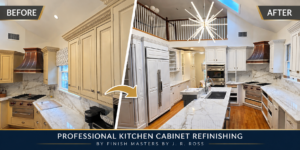
Professional kitchen cabinet refinishing transformation by Finish Masters by J. R. Ross. This before-and-after comparison showcases the transformation from traditional beige cabinetry to an elegant white finish using professional refinishing techniques.
1. What Is Kitchen Cabinet Refinishing?
Kitchen cabinet refinishing is the process of restoring, renewing, or changing the appearance of existing cabinetry while preserving its underlying structure.
Depending on the condition of the cabinets and the desired finish, the process may include removing deteriorated coatings, repairing damaged surfaces, cleaning and mechanically preparing substrates, applying specialized primers, and finishing the cabinetry with protective coatings.
Unlike cabinet replacement, refinishing generally retains the existing cabinet boxes, doors, drawer fronts, and hardware unless specific components require replacement.
The objective is to create an updated appearance while maintaining the structural integrity and functionality of the original cabinetry.
Cabinet Refinishing vs. Cabinet Painting
Although these terms are frequently used interchangeably, cabinet refinishing and cabinet painting are not necessarily equivalent.
Conventional cabinet painting generally involves preparing existing surfaces and applying a residential-grade cabinet enamel.
Professional cabinet refinishing may incorporate more sophisticated processes and materials, including industrial primers and two-component catalyzed coatings engineered for demanding applications.
These systems can offer enhanced resistance to abrasion, household chemicals, staining, and repeated cleaning when properly selected, applied, and cured.
The distinction is not simply whether a coating is sprayed or brushed. It involves the compatibility, application, and performance of the complete finishing system.
Cabinet Refinishing vs. Cabinet Replacement
Cabinet replacement requires removing existing cabinetry and installing new cabinet boxes, doors, and related components.
Replacement may be appropriate when cabinets are structurally compromised, extensively water-damaged, poorly configured, or no longer meet the homeowner’s functional requirements.
However, when existing cabinetry remains structurally sound, professional refinishing can provide a substantial visual transformation without extensive demolition.
2. Benefits of Professional Kitchen Cabinet Refinishing
Preserving Existing Cabinet Construction
Many existing kitchens contain solid wood doors, hardwood face frames, and cabinet boxes that remain structurally serviceable.
Replacing these materials solely because the finish is outdated may be unnecessary.
Professional cabinet refinishing allows homeowners to preserve functional cabinetry while changing the color, sheen, and overall appearance.
Lower Costs Compared With Cabinet Replacement
Professional cabinet refinishing generally costs less than complete cabinet replacement of comparable scope.
However, the cost depends on cabinet construction, existing coating condition, preparation requirements, repairs, and the selected finishing system.
A professional industrial coating process should not be confused with inexpensive residential repainting.
Specialized equipment, controlled finishing environments, extensive preparation, and industrial coating materials contribute to the cost of a professional refinishing project.
Reduced Construction Disruption
Complete kitchen renovations may require cabinet demolition, countertop removal, plumbing modifications, electrical work, and extended periods of limited kitchen access.
Cabinet refinishing can often preserve the existing kitchen layout and minimize construction-related disruption.
At Finish Masters by J. R. Ross, removable cabinet doors and drawer fronts are typically transported to our off-site finishing facility.
This allows much of the preparation and spray-finishing process to occur away from the customer’s home.
Environmental Considerations
Refinishing existing cabinetry reduces the need to discard serviceable cabinet components and purchase replacement materials.
Although refinishing still consumes coatings, abrasives, energy, and other resources, preserving existing cabinetry can reduce unnecessary material replacement.
3. How to Determine Whether Your Cabinets Can Be Refinished
Not every cabinet is a suitable candidate for refinishing.
A professional evaluation should begin with the structural condition of the cabinet boxes, doors, drawer fronts, and existing finishes.
Solid Wood Cabinets
Solid wood cabinetry is frequently an excellent candidate for professional refinishing.
Common wood species include maple, oak, cherry, birch, and poplar.
Each species presents different preparation requirements.
Oak contains a prominent open-grain structure that may remain visible beneath opaque finishes unless additional grain-filling procedures are performed.
Maple generally provides a smoother surface but still requires careful preparation to promote coating adhesion.
MDF and Engineered Wood Cabinets
Medium-density fiberboard, commonly called MDF, is frequently used in painted cabinet doors and decorative components.
Properly manufactured and maintained MDF can provide a smooth substrate for professional coatings.
However, exposed edges, damaged surfaces, and areas affected by moisture may require specialized preparation or replacement.
Previously Painted Cabinets
Previously painted cabinets can often be refinished, provided the existing coatings are sufficiently bonded and compatible with the proposed finishing system.
Applying a new coating over poorly bonded paint does not correct the underlying adhesion problem.
In some cases, existing coatings must be substantially removed before refinishing can proceed.
When Cabinet Replacement Is the Better Option
Cabinet replacement may be more appropriate when existing cabinetry exhibits extensive water damage, structural deterioration, severe delamination, failed construction, or significant layout limitations.
A reputable cabinet refinishing contractor should identify these conditions before recommending a coating system.
4. Why Surface Preparation Is Critical to Cabinet Refinishing
Surface preparation is one of the most important factors affecting the longevity of a cabinet finish.
Even advanced industrial coatings can fail when applied to contaminated, incompatible, or inadequately prepared surfaces.
Kitchen cabinets are particularly challenging because they are exposed to cooking oils, airborne grease, cleaning chemicals, skin oils, moisture, and repeated physical contact.
Removing Grease and Surface Contaminants
Cabinet surfaces must be thoroughly cleaned before mechanical preparation and coating application.
Common contaminants include cooking grease, waxes, silicone-containing products, furniture polish, and cleaning residues.
These substances can interfere with coating adhesion and contribute to premature failure.
The appropriate cleaning procedure depends on the existing finish and substrate.
Mechanical Sanding and Surface Preparation
Sanding removes surface imperfections, reduces coating irregularities, and prepares existing finishes for subsequent coating applications.
Professional preparation requires selecting abrasive grades appropriate for the substrate and coating manufacturer’s instructions.
Excessively aggressive sanding can damage veneers, decorative profiles, and engineered materials.
Insufficient preparation may leave glossy or contaminated surfaces that interfere with adhesion.
Repairing Cabinet Surface Defects
Before applying primer, damaged areas may require repair.
Common repairs include filling minor dents, correcting surface imperfections, repairing loose joints, and addressing damaged edges.
The intended finish influences which repairs are appropriate.
Opaque painted finishes may conceal certain repairs that would remain visible beneath transparent stains.
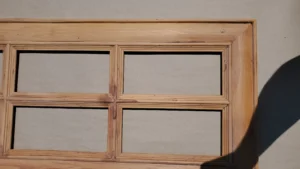
Professional cabinet door sanding and surface preparation before industrial primer application.
5. Understanding Cabinet Primers and Industrial Coating Systems
The coating system selected for cabinet refinishing directly influences appearance, adhesion, chemical resistance, and long-term durability.
Not all cabinet coatings are manufactured for the same performance requirements.
Conventional Residential Cabinet Paints
Many residential painting contractors use commercially available waterborne acrylic, alkyd, or urethane-modified enamel products.
These coatings can produce acceptable results when applied according to manufacturer specifications.
However, performance characteristics vary substantially between products.
Some systems are more susceptible to blocking, abrasion, staining, or chemical exposure than higher-performance industrial finishes.
Homeowners should therefore evaluate the specific coating product rather than relying exclusively on marketing descriptions such as “cabinet-grade paint.”
Industrial Two-Component Cabinet Coatings
Industrial two-component coatings, frequently designated as 2K systems, incorporate components that react during curing to form a crosslinked coating film.
Depending on their chemistry and formulation, these systems can provide enhanced resistance to household chemicals, moisture exposure, abrasion, and staining.
Professional cabinet finishing systems may include catalyzed polyurethane, urethane, and other specialized industrial coatings.
At Finish Masters by J. R. Ross, we utilize professional coating technologies, including industrial two-component waterborne systems, selected according to substrate conditions and project requirements.
Our coating selection emphasizes adhesion, durability, finish consistency, and suitability for the intended application.
Why Primer Compatibility Matters
Primer serves as the interface between the existing cabinet substrate and the finish coating.
A properly selected primer can improve adhesion, help isolate certain contaminants, and provide a consistent surface for subsequent coating applications.
However, primer and topcoat products must be chemically compatible.
Combining products from unrelated coating systems without manufacturer approval can introduce avoidable risks.
Professional refinishers should understand the manufacturer’s technical data sheets, recommended film thicknesses, application conditions, and recoat requirements.
Understanding KCMA Performance Standards
The Kitchen Cabinet Manufacturers Association (KCMA) publishes performance standards for kitchen and vanity cabinetry.
These standards address aspects of cabinet performance, including finish resistance under specified testing conditions.
Homeowners should distinguish between a coating manufacturer’s performance claims and certification of a complete cabinet product.
A coating described as meeting certain KCMA-related testing criteria does not automatically mean that a refinished cabinet installation is KCMA-certified.
The specific product, test method, and supporting documentation should be evaluated before making certification claims.
6. Why Professional Spray Application Matters
The application method significantly influences the final appearance of refinished cabinetry.
Brushes and rollers may leave visible application patterns, texture, or inconsistent film thickness.
Professional spray equipment can provide greater control over coating distribution and surface appearance when operated correctly.
Air-Assisted Airless Spray Technology
Professional air-assisted airless spray systems combine hydraulic fluid pressure with supplemental atomizing air.
This allows operators to adjust coating delivery and atomization characteristics to suit the material and application.
When properly configured, these systems can produce smooth, uniform finishes on cabinet doors, drawer fronts, and other components.
However, equipment alone does not guarantee quality.
Operator experience, spray technique, coating viscosity, environmental conditions, and surface preparation remain essential.
Benefits of Off-Site Cabinet Spray Finishing
Removing cabinet doors and drawer fronts for refinishing provides several practical advantages.
An off-site finishing facility allows greater control over dust, airborne contamination, component positioning, spray application, drying conditions, and quality inspection.
At Finish Masters by J. R. Ross, removable cabinet doors and drawer fronts are professionally prepared and sprayed in our off-site finishing facility.
This approach reduces the amount of finishing activity required inside the customer’s home.
Why Application Conditions Matter
Temperature, humidity, airflow, and contamination can affect coating performance.
Improper conditions may contribute to surface defects, inconsistent drying, or curing problems.
Two-component coatings also require careful handling and appropriate occupational safety controls.
Certain catalyzed coating systems contain hazardous constituents, and their application must follow manufacturer safety instructions, including applicable respiratory protection and ventilation requirements.
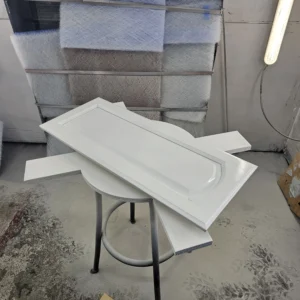
White cabinet door refinished in Windham NH, showcasing professional cabinet refinishing services.
7. Our Professional Kitchen Cabinet Refinishing Process
Although every project requires an individualized scope of work, our general refinishing process follows a structured sequence.
Step 1: Initial Cabinet Evaluation
We begin by evaluating cabinet construction, existing finishes, surface conditions, and the desired appearance.
This assessment helps identify necessary repairs, coating compatibility considerations, and project-specific requirements.
Step 2: Color and Sheen Selection
Homeowners select their desired finish color and sheen.
Available options may include whites, off-whites, grays, charcoal tones, contemporary neutrals, and custom color selections.
Sheen selection affects both appearance and how surface imperfections are perceived.
Step 3: Cabinet Door and Drawer Removal
Cabinet doors and drawer fronts are carefully removed, identified, and transported to our finishing facility.
Components are organized to facilitate accurate reinstallation.
Step 4: Cleaning and Mechanical Preparation
Existing surfaces undergo appropriate cleaning, mechanical preparation, and necessary repairs.
Preparation requirements vary depending on cabinet materials and the condition of the existing finish.
Step 5: Professional Primer Application
A compatible professional primer is applied according to the selected coating system.
Additional preparation may be required between coating stages to achieve the intended surface quality.
Step 6: Industrial Finish Application
Doors and drawer fronts receive the specified finish system using professional spray equipment.
The number of applications, required film thickness, and recoat intervals depend on the coating manufacturer’s instructions and project requirements.
Step 7: In-Home Cabinet Refinishing
Cabinet frames and other fixed components are prepared and refinished on-site using application methods appropriate to the selected coating system and occupied residential environment.
Our off-site industrial spray process for removable components should not be confused with applying catalyzed coatings indiscriminately inside occupied living spaces.
Step 8: Reinstallation and Final Inspection
Following the required handling and curing intervals, refinished components are reinstalled.
Final adjustments and inspections help verify appearance, alignment, and completion of the agreed scope of work.
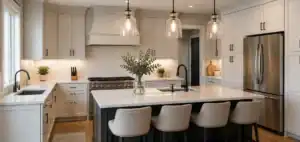
Completed kitchen cabinet refinishing project showing installed doors, drawer fronts, and finished cabinet frames.
Recommended image: Completed kitchen cabinet refinishing project showing installed doors, drawer fronts, and finished cabinet frames.
8. How Long Does Kitchen Cabinet Refinishing Take?
The duration of a cabinet refinishing project depends on several factors.
These include the number of cabinet components, existing finish condition, repairs, coating requirements, and logistical considerations.
A typical project may involve separate periods for off-site preparation, in-home refinishing, and final installation.
At Finish Masters by J. R. Ross, we commonly coordinate the off-site and in-home portions to minimize unnecessary disruption.
However, homeowners should distinguish between the time required to complete installation and the time required for a coating to achieve its specified final cure.
Cabinets may be ready for careful use before the coating has reached its maximum designed performance.
The manufacturer’s curing instructions should always govern handling, cleaning, and return to normal service.
9. How Much Does Professional Cabinet Refinishing Cost?
Professional cabinet refinishing costs vary substantially.
An accurate proposal should account for more than the number of cabinet doors.
Factors That Influence Cabinet Refinishing Prices
Important considerations include:
-
Number and dimensions of cabinet doors
-
Number of drawer fronts
-
Cabinet frame and exposed panel areas
-
Existing coating condition
-
Cleaning and preparation requirements
-
Repairs and substrate defects
-
Selected primer and finish system
-
Color changes and specialty finishes
-
Hardware removal and reinstallation
-
Transportation and project logistics
Projects involving extensive repairs or coating removal may require considerably more labor than cabinets in good condition.
Why Cabinet Refinishing Estimates Vary
Homeowners frequently receive substantially different proposals for what initially appears to be the same project.
However, two estimates may include very different preparation procedures, coating products, application methods, and warranty provisions.
One contractor may propose a conventional residential enamel applied on-site.
Another may specify extensive preparation, industrial primers, off-site spray finishing, and a catalyzed coating system.
These are not necessarily equivalent scopes of work.
When comparing proposals, homeowners should request the specific coating products, preparation procedures, application methods, warranty terms, and exclusions in writing.
The lowest initial price does not necessarily represent the lowest long-term cost.
10. How Long Do Professionally Refinished Cabinets Last?
There is no universal service-life guarantee for cabinet refinishing.
Durability depends on the substrate, surface preparation, coating system, application quality, environmental exposure, and maintenance practices.
A professionally applied industrial coating system can provide many years of service when appropriately maintained.
However, even durable finishes remain vulnerable to impact damage, excessive moisture exposure, abrasive cleaning, and misuse.
Homeowners should distinguish between expected service life and the specific duration of a written workmanship warranty.
A warranty is a contractual commitment governed by its stated terms and exclusions; it is not necessarily a prediction of when a coating will fail.
11. Choosing the Best Cabinet Color and Finish
Cabinet refinishing provides homeowners with substantial design flexibility.
White and Off-White Cabinets
White and off-white finishes remain popular because they complement many countertop materials, flooring selections, and architectural styles.
They can also create a brighter appearance in kitchens with limited natural light.
Gray and Charcoal Cabinets
Gray and charcoal tones offer a more contemporary appearance.
Darker finishes can be particularly effective on kitchen islands, lower cabinets, or contrasting cabinetry.
Two-Tone Cabinet Designs
Two-tone kitchens combine different colors between upper and lower cabinets or between perimeter cabinetry and a central island.
This approach can introduce visual contrast without changing the existing cabinet layout.
Satin, Semi-Gloss, and Other Sheens
Sheen affects light reflection, perceived surface texture, and overall appearance.
Satin finishes are often selected for their relatively subdued appearance.
Higher-sheen finishes reflect more light and may emphasize certain surface imperfections.
The best selection depends on the homeowner’s preferences and the characteristics of the coating system.
12. Common Cabinet Refinishing Problems and Their Causes
Understanding common coating failures helps homeowners evaluate the importance of professional preparation and application.
Peeling and Adhesion Failure
Peeling may occur when coatings are applied over contamination, incompatible finishes, or inadequately prepared surfaces.
Correcting adhesion failure often requires removing poorly bonded material and properly preparing the underlying substrate.
Chipping and Impact Damage
Cabinet edges, corners, and frequently handled areas are particularly vulnerable to physical damage.
Coating durability, substrate characteristics, and handling practices influence resistance to chipping.
Brush Marks and Roller Texture
Visible application marks can result from unsuitable tools, material properties, or application techniques.
Professional spray application can reduce these defects when performed under appropriate conditions.
Bubbles, Craters, and Surface Defects
Surface defects may result from contamination, improper application, excessive film thickness, trapped air, or environmental conditions.
Accurate diagnosis is necessary before attempting repairs.
Blocking and Premature Handling
Blocking occurs when coated surfaces stick together under pressure.
This may be associated with insufficient drying or curing, unsuitable coating selection, or unfavorable environmental conditions.
Following manufacturer instructions is particularly important during the initial curing period.
13. How to Maintain Professionally Refinished Cabinets
Proper maintenance helps preserve the appearance and performance of refinished cabinetry.
Routine Cleaning
Use a soft cloth and a mild cleaning solution approved for the coating system.
Avoid aggressive scrubbing and abrasive cleaning pads.
Avoid Harsh Chemicals
Strong solvents, abrasive powders, and incompatible cleaning products may damage certain cabinet finishes.
Always follow the coating manufacturer’s care recommendations.
Address Moisture Promptly
Although professional cabinet coatings may provide moisture resistance, prolonged standing water can damage joints, exposed edges, and underlying substrates.
Clean spills promptly and investigate persistent moisture problems.
Protect High-Contact Areas
Repeated impacts from cookware, appliances, and other hard objects can damage cabinet surfaces.
Proper hardware adjustment and careful handling can help reduce unnecessary wear.
Follow Initial Curing Instructions
Newly refinished cabinets may require special care during the initial curing period.
Avoid aggressive cleaning or unnecessary impact until the coating has achieved the appropriate degree of cure.
14. DIY Cabinet Painting vs. Professional Cabinet Refinishing
DIY cabinet painting can be appropriate for homeowners who understand the preparation requirements and accept the limitations of their selected materials and equipment.
However, professional cabinet refinishing involves additional technical considerations.
These include substrate identification, coating compatibility, contamination control, application equipment, environmental conditions, and curing requirements.
Homeowners should also understand that certain industrial coatings are not suitable for casual residential application.
Two-component systems may require specialized ventilation, protective equipment, and trained personnel.
Professional refinishing is therefore not simply a matter of purchasing more expensive paint.
It is a coordinated process involving material selection, preparation, application, and quality control.
15. Frequently Asked Questions About Kitchen Cabinet Refinishing
Is cabinet refinishing worth the investment?
Cabinet refinishing can be a worthwhile investment when existing cabinetry is structurally sound and the homeowner is satisfied with the general kitchen layout.
It offers an opportunity to update appearance without the full cost and disruption of cabinet replacement.
Can oak cabinets be refinished with a smooth painted finish?
Yes. Oak cabinets can be refinished with an opaque painted finish.
However, their natural grain structure may remain visible unless additional grain-filling procedures are performed.
Can previously painted kitchen cabinets be refinished?
Yes, provided the existing coatings and substrates are suitable.
Poorly bonded or incompatible finishes may require removal or specialized preparation.
Are industrial cabinet coatings better than regular paint?
Industrial coatings may offer enhanced performance characteristics, but results depend on the specific product and application.
A properly selected and applied system is more important than a broad product category or marketing description.
Can cabinet doors be sprayed off-site?
Yes. Removing doors and drawer fronts for off-site finishing allows greater control over preparation, spray application, and environmental conditions.
Will refinished cabinets look like factory-finished cabinets?
Professional spray refinishing can produce a smooth, uniform appearance comparable in certain respects to factory-applied finishes.
However, the final result depends on the existing substrate, cabinet construction, coating system, and preparation requirements.
Do refinished cabinets require special cleaning products?
Most professionally finished cabinets can be maintained with mild, nonabrasive cleaning products approved for the coating.
Specific maintenance requirements depend on the manufacturer’s recommendations.
Can cabinet refinishing be completed without replacing countertops?
In many cases, yes.
Cabinet refinishing generally preserves the existing cabinet layout and can often be completed without removing countertops.
Is cabinet refinishing available for bathroom vanities?
Yes. Many of the same preparation and finishing principles apply to bathroom vanity cabinetry.
However, the selected materials and coatings must be appropriate for the expected moisture exposure.
What should I ask a cabinet refinishing contractor before hiring?
Ask about the specific coating products, surface preparation procedures, application methods, off-site finishing capabilities, insurance coverage, written contract, and warranty provisions.
A professional contractor should be able to explain the proposed system and identify any limitations affecting the project.
16. Professional Cabinet Refinishing in Massachusetts and Southern New Hampshire
Finish Masters by J. R. Ross provides professional cabinet refinishing and cabinet painting services for residential properties throughout our Massachusetts and Southern New Hampshire service areas.
Our service region includes communities such as Nashua, Hollis, Amherst, and Merrimack in New Hampshire, as well as Westford, Chelmsford, Groton, Acton, and surrounding Massachusetts communities.
Our approach emphasizes careful substrate evaluation, detailed surface preparation, professional coating selection, and controlled spray finishing for removable cabinet components.
We recognize that homeowners are not simply purchasing a new cabinet color. They are investing in the appearance, usability, and long-term maintenance of one of the most frequently used areas of their homes.
Our objective is to provide a clearly defined scope of work, appropriate materials, professional workmanship, and written warranty terms applicable to the selected finishing system.
To explore the communities we serve, visit our Massachusetts and New Hampshire service areas.
17. Why Homeowners Choose Finish Masters by J. R. Ross
Selecting a cabinet refinishing contractor requires evaluating more than the quoted price.
Homeowners should consider the contractor’s experience, preparation procedures, coating materials, application methods, project documentation, and warranty provisions.
Finish Masters by J. R. Ross is a veteran-owned construction and finishing company serving Massachusetts and Southern New Hampshire.
Our cabinet refinishing services emphasize:
-
Professional substrate evaluation and surface preparation
-
Industrial coating systems selected for the application
-
Off-site spray finishing of removable cabinet components
-
Controlled application methods
-
Written project scopes and contractual documentation
-
Written warranty provisions applicable to the selected finishing system
Our goal is to provide homeowners with a technically informed, professionally executed alternative to conventional cabinet repainting and unnecessary cabinet replacement.
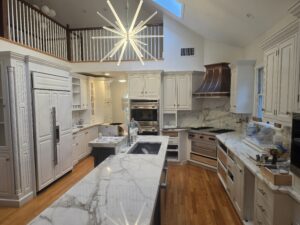
Professional kitchen cabinet refinishing by Finish Masters by J. R. Ross, featuring elegant white cabinetry, detailed architectural millwork, and a beautiful marble countertop design.
Conclusion: Choosing the Right Cabinet Refinishing Process
Kitchen cabinet refinishing can provide a substantial aesthetic transformation while preserving existing cabinetry and avoiding unnecessary replacement.
However, the quality of the result depends on the entire process.
Surface preparation, substrate compatibility, primer selection, coating chemistry, application conditions, and curing requirements all influence the finished product.
For homeowners considering cabinet refinishing, the most important decision is not simply choosing a color or comparing prices.
It is understanding what work will be performed, which materials will be used, and how the contractor intends to deliver a durable, professionally finished result.
At Finish Masters by J. R. Ross, we believe informed homeowners are better equipped to evaluate their options and make sound decisions about their property.
Considering Professional Cabinet Refinishing?
If your kitchen cabinets are structurally sound but outdated, professional refinishing may offer an attractive alternative to replacement.
Explore our professional cabinet refinishing services to learn more about our process, or contact Finish Masters to begin discussing your project.
Finish Masters by J. R. Ross
Massachusetts & Southern New Hampshire
Phone: 978-600-1979
Website: https://myfinishmasters.com/
About the Author
James R. Ross II
Finish Masters by J. R. Ross
James R. Ross II is the owner of Finish Masters by J. R. Ross, a veteran-owned construction and professional finishing company serving Massachusetts and Southern New Hampshire.
His background includes a Bachelor of Science degree in Biochemistry and practical experience with professional cabinet refinishing, industrial coating systems, substrate preparation, and spray application technologies.
His technical approach emphasizes understanding coating chemistry, surface preparation, material compatibility, and application procedures rather than relying exclusively on conventional residential painting methods.
This article is intended to help homeowners better understand the technical considerations involved in professional cabinet refinishing and make informed decisions when evaluating refinishing contractors.